Durable memory for coding agents. Local by default.
Install the Apache-2.0 core, connect your agent, and inspect memory across sessions. A later session from the same user and connected coding agent can recall scoped project decisions with their history attached. Pro adds hosted memory health views, scheduled upkeep, and optional sync.
The complete local core is free and needs no account. Optional Pro: 7-day trial after email verification, no card required; $10/month or $100/year when you subscribe.
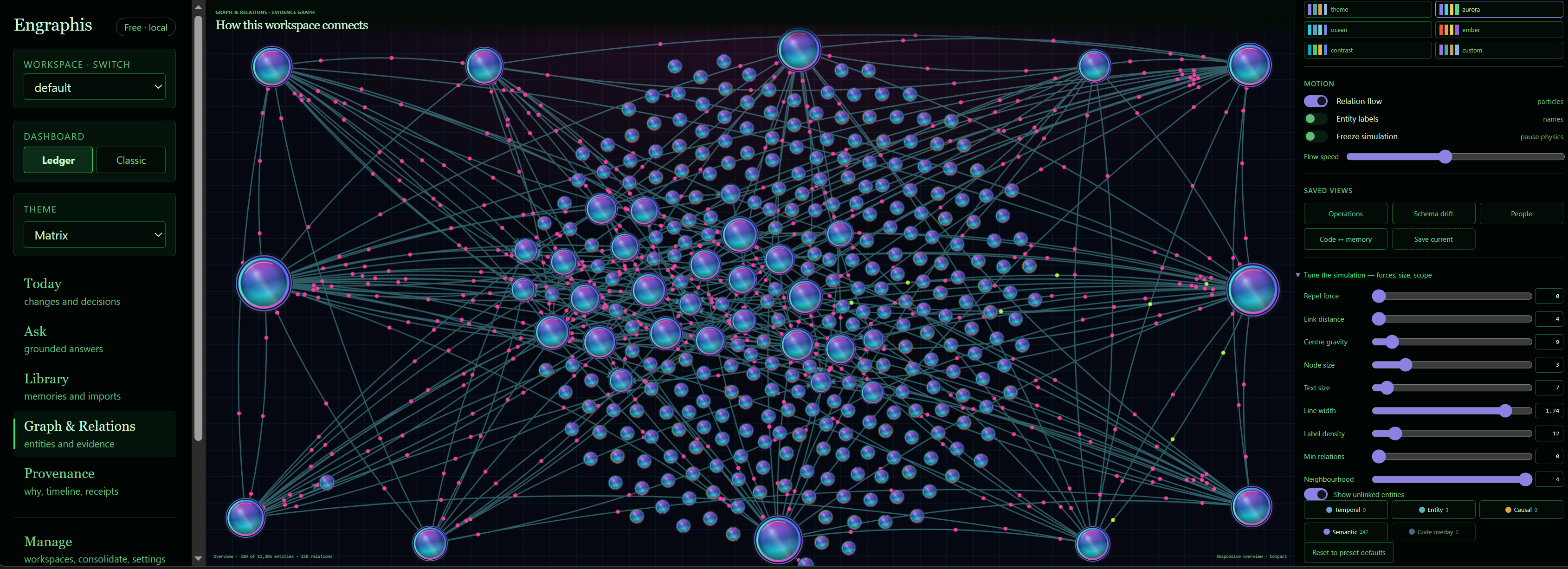
See what your agent knows and why
Related memories form a local graph, so you can inspect connections, history, and recall rationale without sending data away.
The browser demo uses seeded sample data. It shows local inspection workflows, not a connected Pro account.
Recall context with the same agent
A later session from the same user and connected coding agent can recall saved project memory with its scope and history.
Bound memory to the work
Recall can stay scoped to a workspace, repository, and session instead of becoming one undifferentiated store.
Trace content and history
Inspect recalled memory, its connections, its history, and the rationale behind recall.
Set up the free local core
Connect a coding agent, open the local dashboard, or use the same memory service directly from Python.
Connect your coding agent
Inspect memory visually
Embed Engraphis in an application
Published setup recipes cover Claude Code, Cline, Codex, Cursor, Windsurf, and Zed. Start with the agent connection guide and your client's current configuration instructions. The command above is the Claude Code recipe; configuration recipes are not a claim of current client certification.
The installed service uses a local embedding model (approximately 80 MB on first download), with a deterministic offline fallback. The core Python factory defaults to the offline embedder.
Memory tools your coding agent can use
The default Smart profile exposes 9 Smart MCP tools with advanced discovery for recall, governance, code awareness, and session lifecycle, with workspace, repository, and session scope. Start it with engraphis-mcp. The optional Classic profile exposes 43 direct tools through engraphis-mcp-classic. See the shipped MCP guide.
| Category | Tool | What it does |
|---|---|---|
| Read | engraphis_conflict_review | List pending/quarantined/conflicting memories |
| Read | engraphis_discover_actions | Discover an advanced Engraphis capability |
| Action | engraphis_execute_action | Execute a discovered stateful action |
| Read | engraphis_execute_read | Execute a discovered read action |
| Read | engraphis_get_memory | Read one memory's governed record |
| Action | engraphis_recall_context | Recall compact project context |
| Action | engraphis_remember | Remember a durable fact |
| Action | engraphis_session | Start or end a memory session |
| Action | engraphis_update_memory | Edit a memory's metadata fields |
Configure it locally
Run engraphis-init to write owner-private ~/.engraphis/config.env, or set process environment variables. Engraphis does not search the working directory for a .env file. Set ENGRAPHIS_ENV_FILE to an absolute path to use another trusted config file.
| Env var | Default | Description |
|---|---|---|
ENGRAPHIS_DB_PATH | Per-user data directory | Installed database location below; ordinary relative overrides resolve from the trusted config directory |
ENGRAPHIS_HOST | 127.0.0.1 | Server bind address |
ENGRAPHIS_PORT | 8700 | Dashboard port |
ENGRAPHIS_API_TOKEN | Not set | Optional bearer token for the local REST API |
ENGRAPHIS_EMBED_MODEL | sentence-transformers/all-MiniLM-L6-v2 | Local sentence-transformers model for the installed service |
ENGRAPHIS_LLM_PROVIDER | openai | Provider for optional LLM features |
ENGRAPHIS_LLM_API_KEY | Not set | Provider key for optional LLM features |
Installed database defaults: Windows %LOCALAPPDATA%\engraphis\engraphis.db (or ~\AppData\Local\engraphis\engraphis.db); macOS ~/Library/Application Support/engraphis/engraphis.db; Linux $XDG_DATA_HOME/engraphis/engraphis.db (or ~/.local/share/engraphis/engraphis.db). Source checkouts use <repository>/engraphis.db.
The local core is free and requires no license key. Pro and Team use the authenticated account portal and online authorization for hosted features.
Evaluate memory without giving up control
Use the same questions for every option: where context lives, how agents integrate, what operators can inspect, and what changes when a team shares memory.
The local core is free. Upgrade for hosted workflows.
Community includes the local engine, MCP server, dashboard, CLI, and library. Pro helps you review memory health, schedule upkeep, and opt into hosted sync; Team adds account roles, seats, and audit history. Current availability limits are listed below.
Free
For running and managing memory locally
- The complete recall engine, unlimited on your machine
- MCP server, dashboard with Memory Inspector, CLI, library
- Yours under Apache-2.0, free forever
Pro
For one owner reviewing memory health and scheduling upkeep
- Everything in Community
- Analytics: growth, retention, and decay forecasts
- Auto Consolidation and Auto Dreaming
- Free Jev decisions: up to 500 calls/day; calls pause at the daily limit
- Optional hosted Cloud Sync
Team
For managing members and scoped account access
- Everything in Pro
- Free Jev decisions for every named seat: up to 500 calls/day each; calls pause at the daily limit
- Multi-user admin, member, and viewer roles
- Seat management and per-user audit history
- Scoped agent and sync credentials
- Optional sync for eligible workspaces
- Confirm current Team access before use
Check Team availability in the account portal before starting.
Included Jev: Pro and Team include up to 500 managed Jev calls per person per day at no extra charge; additional calls pause until the limit resets. See how Jev works.
Start a 7-day Pro or 14-day Team trial after confirming your email; no card is required. Team trials include 5 trial seats. Stripe handles paid checkout inside the authenticated account portal, and hosted paid features use online authorization. Free local use remains offline-capable and free forever.
Shared workgroup memory: One secure memory shared across teammates and coding agents is a longer-term need, separate from today's Team account features. The founding Team pilot explores that need with a scoped early-access team.
The Team offer covers account roles, named seats, scoped credentials, organization audit history, and optional sync for eligible workspaces. Shared hosted Team memory and hosted MCP are not yet available. Check Team availability before starting. The founding Team pilot is a separate attended path with its own written scope; general availability is not claimed.
Manage account billing, recover access by email, or use private account support. Resend verification from your account page.
Memory is only half the job. Jev adds judgment.
Your agent can retrieve the right memory and still face a hard call: is this command safe, do these facts contradict, is the evidence strong enough, or is the task actually complete? Jev is a System 1 decision engine that returns typed probabilities for those moments, so your agent can act with more context without handing over authority.
Ask for one decision
The agent selects the command, memory excerpt, or evidence and asks one fixed question type. For a decision, Jev receives the question type and the bounded text you select; known secret patterns are filtered before sending, and arbitrary prose is not guaranteed secret-free. Each call needs explicit consent and a public or internal classification.
Probabilities, not prose
Jev answers a yes/no, multiple-choice, or rubric question with a probability and an explicit uncertainty signal. Uncertain or unavailable results stay visible instead of being invented.
Your code decides
The result is advice. Your permissions, tests, approval prompts, and memory rules remain authoritative. Jev never writes memory, authorizes a command, or certifies completion.
- Screen a command
- Classify a mutating shell command before it runs and decide whether to escalate. The harness still enforces its own permissions.
- Catch a contradiction
- Compare a new fact with an existing memory and surface a possible contradiction for review instead of silently overwriting it.
- Weigh the evidence
- Check whether the selected evidence actually supports an answer before the agent cites it, or abstains when support is weak.
- Verify completion
- Compare a goal with the reported output and recent actions to catch an overconfident “done” before you rely on it.
Included with Pro and Team, enabled by the deployed control service: up to 500 managed Jev calls per person per day; additional calls pause until the limit resets, with no personal TypeSafe key and no overage charge. Local heuristics remain available with no account or provider key; BYOK is optional. Jev is advisory.
A local memory engine. Three reasons to add Pro.
The complete local engine stays free. Pro adds hosted tools for understanding and maintaining the memory you choose to connect.
- See what needs attention
- Review memory growth, retention, and decay forecasts in Analytics. Use the results to decide what to revisit; a new workspace may need more history before those signals are useful.
- Schedule memory upkeep
- Choose when Auto Consolidation and Auto Dreaming run. Managed automation produces proposals for review before local changes; manual consolidation remains part of the free core.
- Choose hosted sync
- Connect an eligible local workspace to Cloud Sync. You hold the workspace encryption key. Sync and readable managed processing require separate choices.
Use the trial on a real workspace.
Start with project memory you already use. The goal is a completed result that helps you decide what needs attention.
- Verify your email and connect your installation. Your seven-day trial starts after verification. Run the current connect command from your account on your own machine.
- Choose your workspace and data boundaries. For Cloud Sync, configure and securely back up your user-held encryption key. Review managed-processing consent separately before using Analytics or automation.
- Inspect a completed Pro result. Review Analytics for a useful growth, retention, or decay signal. If there is too little history, keep that limitation visible. Schedule automation only when you choose it.
New to Engraphis? Set up the free local core first and try one convention across two sessions. Already using it? Connect your existing workspace. Get private account help if setup gets in the way.
Install the local core.
Free and open-source. Keep your memory on your machine; hosted sync and readable managed processing are separate opt-in choices.
Optional Pro: 7-day trial after email verification; no card required. $10/month or $100/year when you subscribe.